
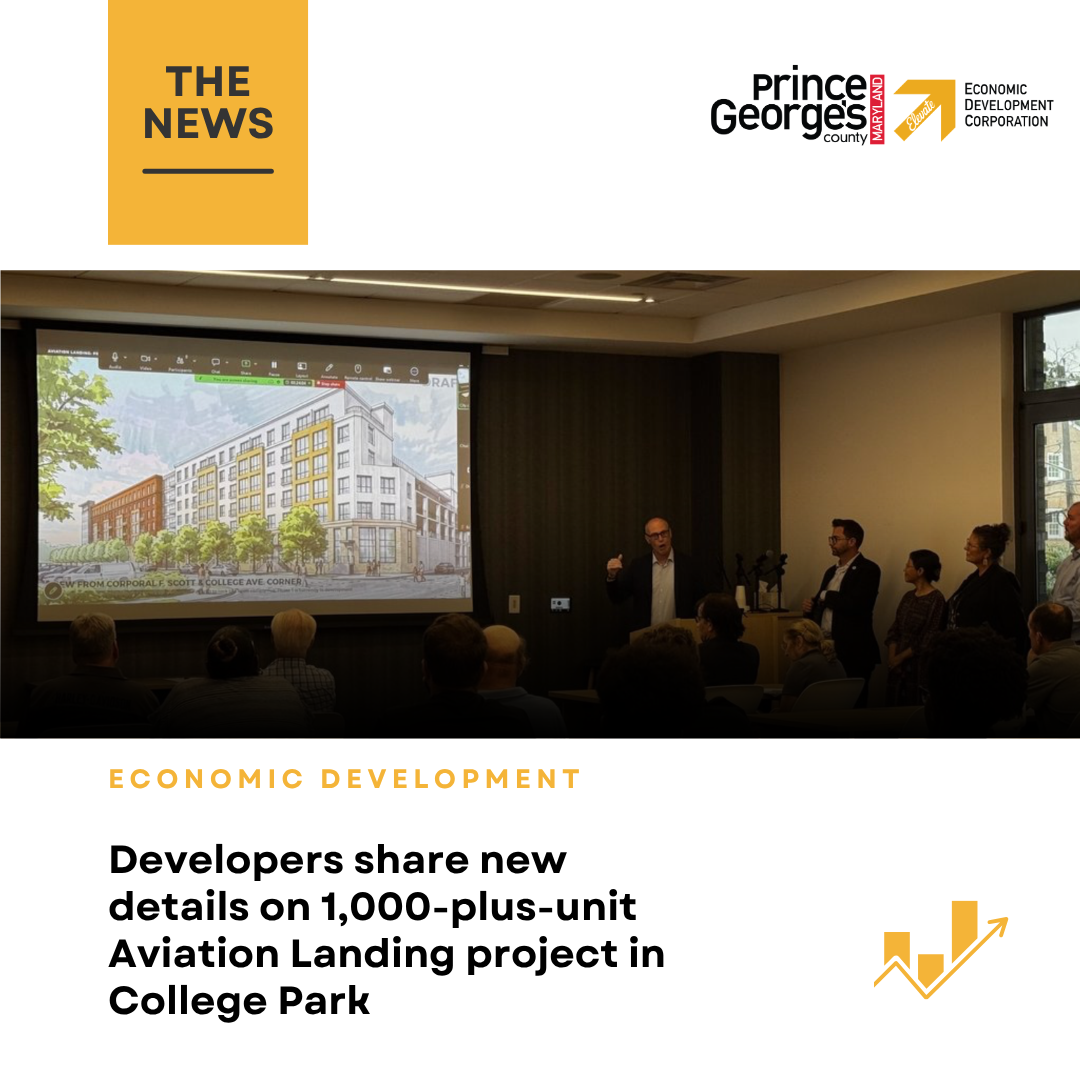
A major mixed-use development planned for College Park is moving forward with a renewed vision that could bring new housing, retail activity, jobs and investment to one of Prince George’s County’s most important innovation corridors.
As reported by Hannah Ziegler of the Washington Business Journal, developers recently shared new details about Aviation Landing, a large-scale project near the College Park Airport that was originally announced in 2022 but faced delays related to stormwater management. The development team discussed its updated plans during an August 27 pre-application community meeting.
The latest broader proposal calls for up to 1,400 multifamily residential units, 66,000 square feet of commercial space and 54,000 square feet of retail, according to the City of College Park. An initial phase could include up to 600 residential units and approximately 36,000 square feet of retail and commercial space. Plans remain under review and are subject to change as the project moves through the County development process.
Building Around Prince George’s County’s Innovation Economy
For Prince George’s County, Aviation Landing represents more than a real estate project. Its location places new development near the University of Maryland, College Park Metro, the future Purple Line, College Park Airport and the growing Discovery District—creating the potential for a more connected environment where residents, researchers, entrepreneurs and businesses can live, work and collaborate.
That connectivity is particularly important as College Park continues developing into a regional hub for research, technology and entrepreneurship. Terrapin Development Company describes its broader Greater College Park strategy as creating a walkable community that supports both local economic vitality and a growing research and entrepreneurial ecosystem.
For County businesses, increased residential density and commercial activity can translate into a larger customer base and greater demand for restaurants, retail, professional services and neighborhood amenities. Development at this scale can also create opportunities for local contractors, suppliers and service providers as investment moves from planning into construction and eventually ongoing operations.
Creating a Platform for Long-Term Growth
The economic potential extends beyond the immediate development site. When Aviation Landing was originally announced, the University of Maryland projected that the full development could ultimately support approximately 2,700 permanent jobs and $370 million in annual economic output. While the project has evolved since those initial projections were released, they illustrate the scale of the economic development opportunity envisioned for the area.
Public investment is also helping move the site toward development. In July, Maryland approved $2.5 million for engineering and predevelopment work associated with relocating a storm drain at the Aviation Landing site, addressing infrastructure necessary for future mixed-use development.
For Prince George’s County, projects like Aviation Landing demonstrate how strategic development can connect housing, transportation, research institutions and commercial activity to strengthen an entire business ecosystem. As College Park continues to attract investment and innovation, the opportunity is not simply to build more—it is to create an environment where existing County businesses can grow alongside new companies, residents and industries.
The next phase will be important to watch. If Aviation Landing successfully leverages its proximity to transit, the University of Maryland and the Discovery District, it could become another catalyst for expanding Prince George’s County’s commercial tax base, creating jobs and positioning College Park as an increasingly competitive destination for business and investment.