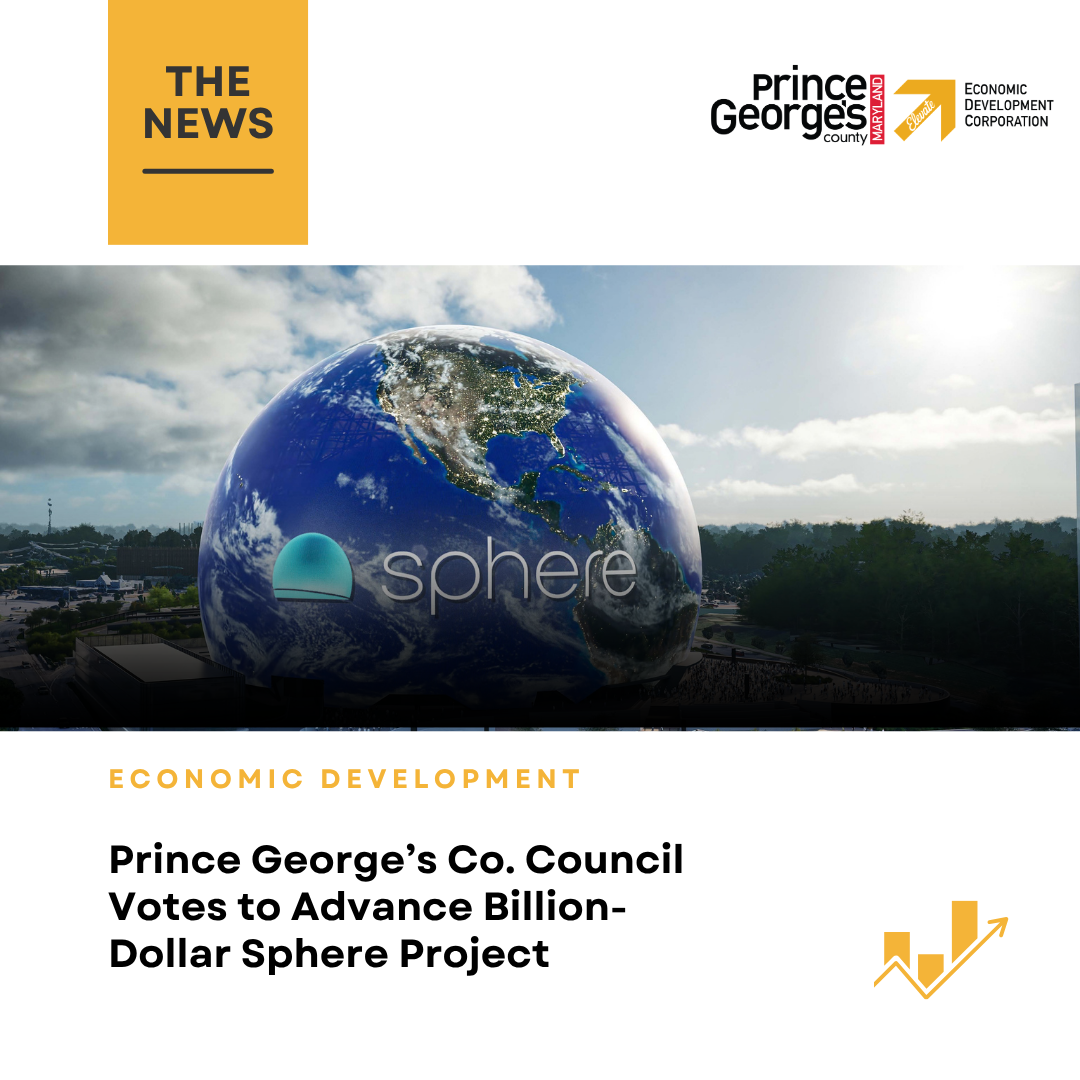
National Harbor Sphere will stand 302 feet, first site plan reveals

New details surrounding the proposed Sphere at National Harbor continue to highlight the transformative potential of the project and its long-term economic impact on Prince George's County.

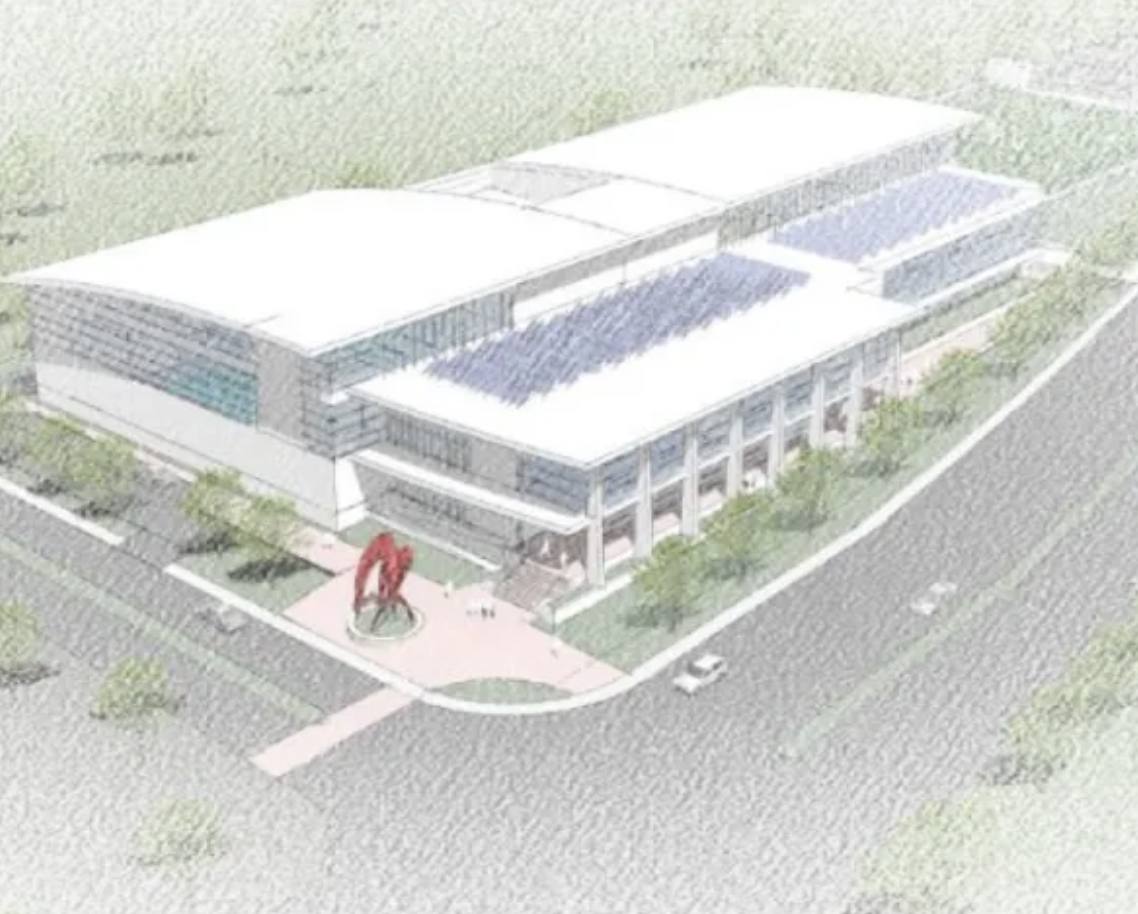
As reported by Hannah Ziegler in the Washington Business Journal, preliminary site plans provide the first detailed look at the proposed entertainment venue, including its layout, height and visitor experience. The plans show the immersive venue rising approximately 302 feet and featuring a 6,000-seat capacity, making it one of the most recognizable landmarks along the County's waterfront.

If approved, the National Harbor location would become the second Sphere venue in the United States and the first to utilize the company's smaller-scale design model. Planned adjacent to MGM National Harbor, the project would further strengthen the area's reputation as one of the region's premier destinations for tourism, entertainment and hospitality.

For Prince George's County businesses, the opportunity extends well beyond entertainment. A world-class attraction has the potential to increase visitor spending across hotels, restaurants, retail establishments and local attractions while creating new opportunities for entrepreneurs, event organizers and hospitality providers. The project could also encourage additional private investment throughout National Harbor, reinforcing the area's role as an economic engine for the County.

The proposed venue also reflects the County's continued focus on attracting destination projects that diversify the local economy and raise Prince George's County's profile on both a national and international stage. Large-scale developments that combine innovation, tourism and technology can generate sustained economic activity while supporting job creation during construction and long after opening day.

While the project continues to move through the planning and approval process, the newly released site details offer another indication of the scale and ambition behind the proposed development. As National Harbor continues to evolve, projects like Sphere have the potential to reinforce Prince George's County as a hub for investment, innovation and unforgettable visitor experiences that benefit businesses and residents alike.

Original Source:
https://www.bizjournals.com/washington/news/2026/07/09/sphere-national-harbor-site-plan-height-layout.html

Elaine Ulrich to Convert the former Cheverly Walgreens into a hardware store.

An entrepreneur's vision to transform a long-vacant commercial property into a neighborhood destination is highlighting the role small businesses continue to play in strengthening Prince George's County's economy.

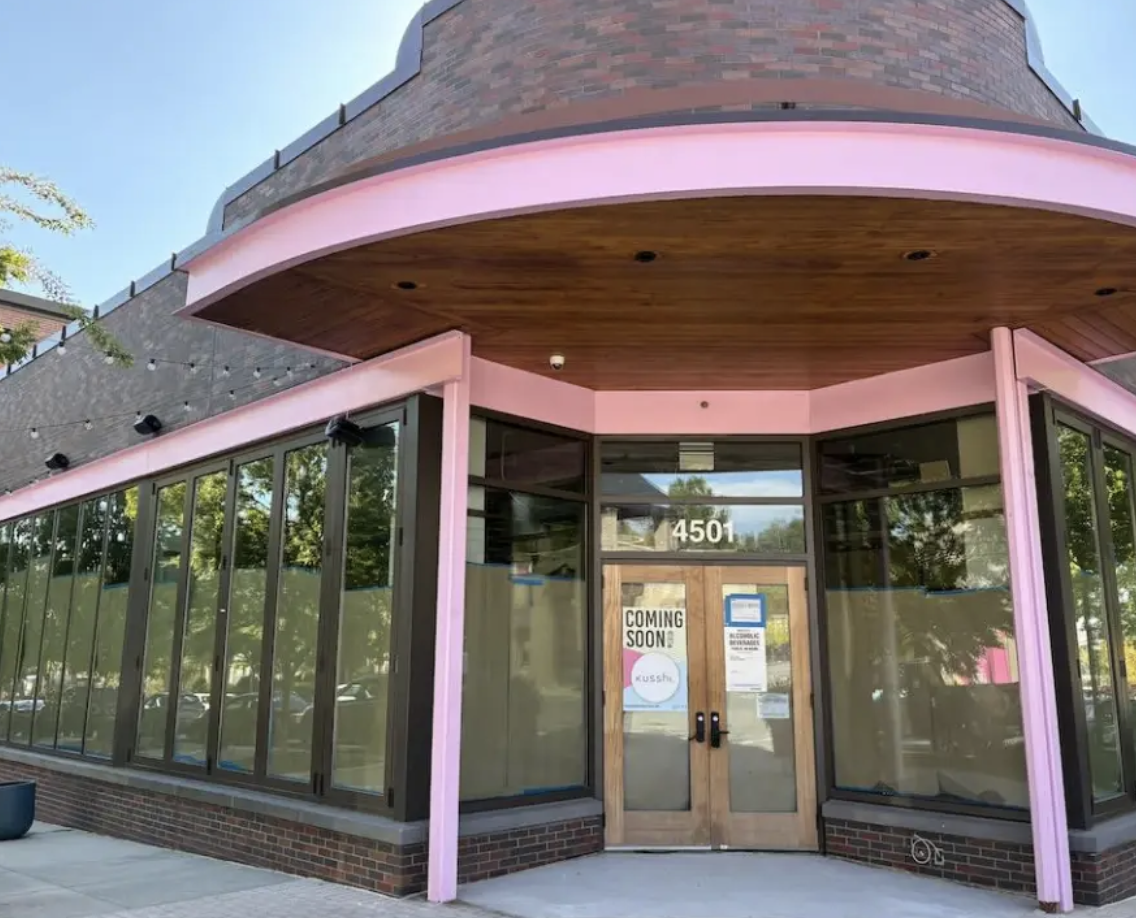
As reported by Michael Neibauer in the Washington Business Journal, former federal scientist Elaine Ulrich plans to redevelop the former Walgreens property on Landover Road in Cheverly into Waxwings Ace Hardware & Café. The project will repurpose the vacant retail space into a locally owned business designed to serve both home improvement needs and the surrounding community.

The redevelopment demonstrates how adaptive reuse can breathe new life into underutilized commercial properties while expanding retail options for residents. By investing in an existing site rather than new construction, the project supports community revitalization, increases commercial activity and reinforces Cheverly's growing appeal as a place to live, work and do business.

For Prince George's County, projects like this underscore the importance of supporting entrepreneurs who are willing to invest in their communities. Locally owned businesses help create jobs, generate economic activity and keep investment circulating within the local economy. Transforming vacant storefronts into active businesses also contributes to stronger commercial corridors and can encourage additional private investment nearby.

The planned combination of a hardware store and café offers a unique community-focused approach that goes beyond traditional retail. By creating a destination where residents can shop, gather and connect, the business has the potential to increase foot traffic while supporting neighboring businesses and enhancing the overall customer experience in the area.

As Prince George's County continues to attract investment across both large-scale developments and locally driven projects, entrepreneurial ventures like Waxwings Ace Hardware & Café demonstrate that economic growth is fueled not only by major investments but also by residents who choose to build businesses, create jobs and invest in the communities they call home.

Original Source:
https://www.bizjournals.com/washington/news/2026/07/09/ace-hardware-cheverly-walgreens-elaine-ulrich.html

250-unit multifamily project near Suitland Metro station set for approval

A proposed affordable housing development near the Suitland Metro Station highlights Prince George's County's continued commitment to expanding housing opportunities while supporting long-term economic growth through transit-oriented development.

As reported by Daniel Zawodny in the Washington Business Journal, Green Street Housing LLC is seeking approval to develop Metro Grove, a three-building, 250-unit multifamily community on approximately seven acres along Silver Hill Road, roughly a quarter-mile from the Suitland Metro Station. The Prince George's County Planning Board is scheduled to consider the project on July 23.

The development would be built in two phases, with the first introducing 200 affordable apartment homes for residents earning between 30% and 70% of the area's median income. A portion of those units would be reserved for households with the greatest housing needs, including individuals transitioning out of foster care and families experiencing or at risk of homelessness.

Beyond increasing the County's affordable housing inventory, Metro Grove represents a strategic investment in creating vibrant, connected communities. Its proximity to Metro and the U.S. Census Bureau positions future residents near employment centers, public transportation and essential services, reducing transportation barriers while supporting workforce mobility.

The project also reflects the growing role that transit-oriented development plays in strengthening local economies. By bringing new residents within walking distance of existing businesses and transit infrastructure, developments like Metro Grove can increase foot traffic, encourage additional retail and commercial investment, and support continued revitalization in the Suitland community.

According to the Washington Business Journal, the project is expected to leverage both federal low-income housing tax credits and financial support from the Prince George's County Department of Housing and Community Development. These funding sources help make the development financially feasible while ensuring long-term affordability for residents.

Metro Grove is also one of the projects benefiting from Maryland's Housing Expansion and Affordability Act, legislation designed to encourage higher-density affordable housing near rail stations throughout the state. The law aims to remove development barriers that can limit the construction of much-needed housing in transit-accessible locations, recognizing that proximity to public transportation creates lasting economic and environmental benefits.

As Prince George's County continues to attract investment and expand access to housing, projects like Metro Grove demonstrate how thoughtful development can address housing affordability while supporting a stronger workforce, attracting future investment and fostering sustainable economic growth across the County.

Original Source:
https://www.bizjournals.com/washington/news/2026/07/15/suitland-affordable-housing-development.html

Gragg Cardona, Mosaic to develop 100 acres by Bowie State MARC station

A major step forward in the redevelopment of the Bowie State University MARC Station area is reinforcing Prince George's County's position as a destination for transit-oriented investment, innovation and sustainable economic growth.

As reported by Daniel Zawodny in The Baltimore Banner and by the Washington Business Journal, development teams have been selected to advance the transformation of nearly 100 acres surrounding the Bowie State University MARC Station into a vibrant mixed-use district featuring new housing, retail, commercial space and enhanced transit infrastructure.

For Prince George's County, the project represents more than a real estate investment. It reflects a broader strategy to create connected communities where residents can more easily live, work, learn and access regional employment centers. By pairing expanded housing opportunities with improved transportation access, the redevelopment has the potential to attract new employers, support existing businesses and encourage private investment throughout the surrounding area.

The station's location along the MARC Penn Line, positioned between Washington, D.C., and Baltimore, creates a strategic advantage for businesses seeking access to one of the nation's largest economic corridors. Improvements planned for the site, including upgraded transit facilities, pedestrian connections and walkable development, can help strengthen workforce mobility while increasing the area's appeal to developers, entrepreneurs and commercial tenants.

The redevelopment also reinforces Bowie State University's role as an economic anchor. As Maryland's oldest historically Black college and university, the institution already contributes significantly to the regional economy through education, research and workforce development. A thriving mixed-use district surrounding the campus can further strengthen partnerships between academia, industry and the private sector while creating new opportunities for innovation and talent retention.

As Prince George's County continues investing in transit-oriented development, projects like the Bowie State MARC Station redevelopment demonstrate how strategic infrastructure investments can help build resilient communities, expand housing options and create an environment where businesses and residents can thrive for decades to come.

Original Source:
https://www.bizjournals.com/washington/news/2026/07/21/bowie-state-university-marc-station-developers.html

LinkedIn Shares Tips on Effective Posting

LinkedIn shared new advice on how to maximize content performance in the app, with a simple checklist of what should be included in every LinkedIn update.

The platform also shared insights into optimizing content for artificial intelligence chatbot citations, with LinkedIn content being among the most referenced source material for AI tools.

First, on general posting tips. LinkedIn has shared a simple checklist for effective content creation in the app, which applies to both creators and brands.

So two to three posts per week, with a question to spark ongoing discussion and engagement.

As per LinkedIn: “Consistency is one of the biggest drivers of reach on LinkedIn. Posting regularly signals to the algorithm that you’re an active, valuable contributor.”

It’s also interesting to note the length here, with LinkedIn advising that creators should post longer updates to maximize interest.

LinkedIn also noted that creators should engage with comments within the first hour of posting, while it also suggested that creators should repurpose their top-performing posts in new formats.  

LinkedIn VP of Marketing Davang Shah also recently shared notes on how to optimize LinkedIn posts for LLM consumption.

According to Shah, creators should write a clean, strong opening line, because that first sentence will generally become the post’s URL.

As per Shah: “LinkedIn uses the first line of your post to generate its URL. Avoid starting with hashtags like #socialmedia, as they create generic URLs and dilute your keyword signal. Instead, lead with your keywords.”

Read More LinkedIn Share Tips on Effective Posting on Social Media Today

NIST Launches Center to Drive the Manufacture of Quantum Technologies

The U.S. Department of Commerce’s National Institute of Standards and Technology (NIST) has announced an agreement with SRI International, a nonprofit research and development institution, to help advance U.S. quantum research, development and manufacturing capabilities. Under the agreement, SRI is establishing the Quantum Manufacturing Engineering Center (QMEC) to accelerate manufacturing of scalable, high-performance quantum components and systems to drive significant growth in the U.S. quantum industry. NIST plans to make an initial investment of $20 million in the center’s activities.

“Quantum science promises to generate new knowledge and technologies that will supercharge scientific research and unlock enormous economic potential,” said Deputy Secretary of Commerce Paul Dabbar. “The new Quantum Manufacturing Engineering Center will bring together top experts to ensure both continued U.S. leadership in quantum technologies and that we are the epicenter of manufacturing quantum systems at scale to drive advances in sensing, communications, encryption, computing, biomedicine and other critical areas.” 

The agreement advances the goals outlined in the Executive Order on Ushering in the Next Frontier of Quantum Innovation, and is another important step in implementing NIST’s Strategy for American Technology Leadership in the 21st Century to accelerate the progress of critical and emerging technologies from development to adoption, in close partnership with U.S. industry. This partnership with SRI provides a key platform to advance “the commercial readiness of quantum sensing and quantum-sensor manufacturing” by “supporting research and development pathways that advance quantum-enabling technologies and eliminate manufacturing barriers,” as called for in the June 22, 2026, executive order.

Original Article: https://www.nist.gov/news-events/news/2026/06/nist-launches-center-drive-manufacture-quantum-technologies

University of Maryland Grant Targets Quantum and AI Tools for Cancer Research

The University of Maryland is backing a new effort to use quantum computing and artificial intelligence to speed the search for better ways to detect and treat cancer.

The project is one of 11 research efforts funded through the university’s Grand Challenges Grants Program, a three-year initiative that will provide nearly $15 million for work aimed at major social, health and technology problems, according to a university press release. The cancer project is supported as a team grant and brings together researchers from the A. James Clark School of Engineering and the College of Computer, Mathematical, and Natural Sciences.

The research will focus on single-atom catalysts, a class of materials made by placing isolated metal atoms on a supporting surface, according to the university. These materials can drive chemical reactions with high precision and have drawn interest as possible tools in cancer treatment and detection. In cancer therapy, they may help alter the tumor microenvironment, the local area around cancer cells that can influence how tumors grow, resist treatment and respond to therapy.

The University of Maryland team — which includes which includes Teng Li, Keystone Professor, Department of Mechanical Engineering, Maryland Energy Innovation Institute; Lianping Wu, assistant research professor of mechanical engineering and Xiaodi Wu, associate professor of computer science — plans to combine quantum computing and machine learning to design these catalysts more quickly and more accurately than conventional methods allow, according to the project summary. The goal is to build a predictive framework that can identify promising materials for cancer detection and therapy before they move into laboratory testing.

Original Article: https://thequantuminsider.com/2026/06/26/university-of-maryland-grant-targets-quantum-and-ai-tools-for-cancer-research/?utm_source=Sutor-Group-Intelligence-and-Advisory&utm_medium=daily-links&utm_campaign=Substack

A New Kind of Entanglement Helps Quantum Sensors Tune Out Noise

Photon exchange through an optical cavity links two atomic ensembles, creating a shared entangled state. This entanglement is designed to be insensitive to common noise while remaining highly sensitive to differential signals. (Credit: Raphael Kaubruegger, JILA)

In a quest to build the most accurate sensors in the world, scientists are constantly improving their performance. Making them more precise, stable and reliable.

But eventually, physical constraints will prevent further improvements. 

“By fully embracing the laws of quantum physics, one can expand the performance limits imposed by these constraints,” says JQI Fellow Alexey Gorshkov, who is also a Physicist at the National Institute of Standards and Technology (NIST), a Fellow of the Joint Center for Quantum Information and Computer Science and an Associate Professor in the Department of Physics at the University of Maryland. “And it's very exciting to come up with protocols that come as close as possible to saturating these limits for different sensing tasks.”

Even the most precise sensors in the world are not fully isolated and are limited by noise—subtle disturbances from the environment like vibrations, electromagnetic fields or temperature changes. 

So, Gorshkov, JILA Fellows Ana Maria Rey and James K. Thompson and their colleagues from the Niels Bohr Institute and the Indian Institute of Technology Madras, asked, how can we improve the next generation of sensors despite these limitations? 

Original Article: https://umdphysics.umd.edu/about-us/news/research-news/2108-new-entang.html

Quantum Security Proof Earns Ph.D. Student Top Conference Acceptance

Computer science Ph.D. student Joseph Carolan developed a new technique for analyzing oracle problems, answering an open question about the quantum security of a key cryptographic method and creating a framework for studying future quantum algorithms.

As the best quantum computers accumulate more qubits and even more hype, computer scientists are still mapping the capabilities and limitations of these new machines.

Since the 1990s, researchers have known that, with enough qubits, quantum computers can quickly break down thousand-digit numbers into their prime factors, threatening some of the most widely used encryption protocols on the internet. In the meantime, among other advances, researchers have also shown that quantum computers can efficiently simulate quantum physics itself, potentially creating promising new opportunities for progress in materials science, chemistry, particle physics and a variety of other fields.

But despite all the progress, proving what these machines can and can’t do is often a painstaking mathematical exercise. Researchers typically start with an idealized model of a computer and a problem of interest, then ask how many resources an algorithm would need to solve it, often considering practical resources like time or memory.

A common way to simplify this analysis is to replace all the messy details of a computation with an all-knowing oracle. In this model of computation, fancifully dubbed the oracle model, all an algorithm can do is pose questions to the oracle and receive answers. If your problem is to find a chest full of treasure among a sea of empty duplicates, the oracle model would let you query one chest at a time, learning at each step whether the queried chest contained the treasure. In the oracle model, the only resource that counts is the number of queries you need to make to find the treasure.

Joseph Carolan, a Ph.D. student in the Joint Center for Quantum Information and Computer Science (QuICS), has developed a new technique for analyzing a family of oracle problems that had remained stubbornly unresolved for more than a decade. In a 70-page paper accepted at the 58th Annual ACM Symposium on Theory of Computing (STOC 2026), one of the most selective conferences in computer science, Carolan used the oracle model to answer an open question about the quantum security of an important method in cryptography and described a new framework for analyzing other quantum algorithms in the future. He will deliver a talk on the new results at STOC 2026 during the week of June 22–27, 2026. Earlier this year, he presented the research in one of just seven short plenary talks in a full program of more than 130 accepted talks at the 29th Annual Quantum Information Processing Conference.

Original Article: https://quics.umd.edu/about/news/quantum-security-proof-earns-phd-student-top-conference-acceptance

QLab Expands Quantum Computing Access to IBM Platform

The National Quantum Laboratory (QLab) at the University of Maryland has announced a new agreement granting university members and other QLab users remote access to IBM quantum computers.

The facility provides access to quantum computing capabilities for researchers, educators and entrepreneurs. With the new agreement, the UMD community gains access to IBM’s advanced superconducting quantum processor units (QPUs), including IBM Quantum Heron with 156 qubits and IBM Quantum Nighthawk with 120 qubits. The QPUs are cloud-accessible via the IBM Quantum Platform.

QLab will streamline adoption by allowing any UMD department or unit to access these devices. License administration will be managed through the Division of Information Technology, mirroring the process currently used for software licenses and high-performance computing resources.

"We are excited to expand QLab's offering to the university and wider research community from trapped ion systems to other qubit modalities," said Norbert Linke, QLab director. "IBM's processors permit our users access to state-of-the-art superconducting circuit devices for the first time." 

Original Article: https://today.umd.edu/briefs/qlab-expands-quantum-computing-access-to-ibm-platform

Meet Rob Cohen: Helping Turn University Innovation into High-Growth Companies

Elements of this interview sourced from Quick Bits - July 2026 Quantum Startup Foundry Newsletter

Behind every successful startup is more than a great idea. There are mentors, advisors, and experienced professionals who help entrepreneurs navigate the challenging journey from concept to commercialization.

One of those leaders is Rob Cohen, Program Manager with the Maryland Technology Enterprise Institute (Mtech) at the University of Maryland.

As part of Mtech, Cohen helps support early-stage technology companies commercializing university-developed innovations while serving as a regional instructor and mentor for the NSF I-Corps Mid-Atlantic Hub. His work focuses on helping faculty-founded startups survive one of the most critical stages of business development—from customer discovery through securing their first round of venture capital.

With more than 30 years of experience developing products, services, and technology solutions across healthcare, biotechnology, and life sciences, Cohen brings both technical expertise and entrepreneurial insight to every company he mentors.

Prior to joining Mtech, Cohen served as Director and Product Developer for a biotechnology startup, where he developed innovative approaches to managing biological and clinical data while overseeing clinical trial operations. Earlier in his career, he was a Product Development Manager at the National Center for Biotechnology Information at the National Institutes of Health.

His educational background reflects that same multidisciplinary mindset, holding bachelor's and master's degrees in Aerospace Engineering along with an MBA—all from the University of Maryland.

An inventor on more than 30 issued and pending U.S. patents, Cohen continues to help innovators transform promising technologies into scalable businesses that can positively impact communities and industries alike.

Getting to Know Rob

Beyond his professional accomplishments, Cohen believes success is built on discipline, curiosity, and a willingness to take risks.

When asked what advice he would give his younger self, his answer was immediate:

"Take more risks. You have no financial responsibilities. Do something off the wall. Try something. Be wrong—it's okay, you have a safety net. Just do something really cool."

His philosophy also extends into the workplace.

"My wife has a T-shirt that I love," Cohen said. "It says, 'Nobody cares, work harder.'"

Among his biggest workplace pet peeves are laziness and unnecessary penny-pinching.

"If we go out for lunch, we're not going to argue over who had the bigger meal—we just split it," he laughed.

The part of his work that energizes him most is seeing entrepreneurs grow.

"Participating in the I-Corps program at Mtech," he said. "I get to see the light bulb go on for our participants, and then six months later when I check in with them, they've figured out the issues we worked through together. Making a difference energizes me."

Outside of work, Cohen is a private pilot, an avid baseball fan, and a competitive cook.

If his home were ever on fire, after ensuring his family's safety, he'd first save his family's computers, followed closely by his wife's treasured collection of family photographs—or his cherished recipe book.

And if he ever won the lottery?

"I wouldn't tell anybody," he joked. "I'd want to remove financial stress for my family without changing our lifestyle."

His longer-term vision, however, reflects the same commitment to helping others that defines his professional career.

"I'd like to become a philanthropist—particularly supporting programs that educate students and empower young women to become contributing members of society."

Building the Innovation Economy

Leaders like Rob Cohen play an essential role in strengthening Prince George's County's innovation ecosystem by helping entrepreneurs move breakthrough ideas from the laboratory to the marketplace.

Through organizations like Mtech and partnerships throughout the County, innovators are gaining access to mentorship, commercialization resources, and entrepreneurial support that continue to position Prince George's County as a destination for technology, research, and startup growth.

As the Prince George's County Economic Development Corporation continues supporting innovation and entrepreneurship, professionals like Cohen demonstrate that successful ecosystems are built not only on great ideas—but on experienced mentors dedicated to helping others succeed.

Long-Term Lease Renewal Reflects Continued Strength of Prince George's County's Commercial Real Estate Market

Long-term lease renewals remain an important indicator of confidence in a local commercial real estate market. When organizations choose to remain in the same location for decades, it signals stability, sustained demand, and the value of well-managed business properties that continue to meet operational needs.

As reported by MarketersMEDIA, Kenwood Management Company announced a five-year lease renewal with the Prince George's County Government at Lottsford Business Center in Largo. The renewal covers more than 13,000 square feet and continues a tenant relationship that began in 1994, with the facility serving as the home of the County's cable television operations. The agreement represents the fifth consecutive renewal between the two organizations and underscores a long-standing partnership spanning more than three decades.

For Prince George's County, the renewal highlights the importance of retaining existing tenants while continuing to strengthen the County's commercial office market. Long-term occupancy helps stabilize commercial properties, supports property values, and encourages continued private investment in building improvements and surrounding business districts. It also reinforces Largo's position as a strategic employment center with access to major transportation corridors, Metro, healthcare assets, and government services.

Tenant retention is a key component of economic development. While attracting new businesses remains essential, helping existing organizations remain and grow within Prince George's County supports job stability, generates ongoing economic activity, and demonstrates the County's ability to foster long-term business relationships. Continued investment in commercial real estate contributes to a healthy business environment that benefits property owners, employers, employees, and the broader local economy.

Original Article: https://markets.financialcontent.com/stocks/article/marketersmedia-2026-7-7-kenwood-management-company-announces-5-year-renewal-with-prince-georges-county-government-continuing-long-term-relationship-at-lottsford-business-center#google_vignette

New Bowie Food Hall Signals Continued Momentum for Retail and Dining Growth in Prince George's County

Prince George's County's restaurant and retail landscape continues to evolve as new dining concepts invest in the region, creating additional opportunities for economic activity, consumer spending, and job creation. The upcoming opening of Wonder, a technology-enabled food hall concept, at Bowie Town Center reflects growing confidence in the County's retail market and its ability to attract innovative businesses.

As reported by Patch, Wonder is scheduled to open its newest Maryland location on July 30 at Bowie Town Center. The food hall brings together multiple restaurant brands under one roof, allowing customers to order from a variety of dining concepts in a single transaction while offering both dine-in and delivery options.

For Prince George's County, the addition of a new destination dining experience extends beyond expanding food choices for residents. New restaurant investments generate employment opportunities, increase foot traffic for surrounding retailers, and help strengthen commercial centers by attracting repeat visitors. As shopping centers continue to evolve into mixed-use destinations centered around dining and entertainment, innovative concepts like Wonder can play an important role in keeping retail corridors competitive and responsive to changing consumer preferences.

The opening also reinforces the County's appeal as a market for businesses seeking to reach one of Maryland's largest and most diverse consumer bases. Continued investment in retail and hospitality helps support local economic growth, encourages complementary business development, and contributes to vibrant commercial districts that benefit residents, visitors, and the broader business community alike.

Original Article: https://patch.com/maryland/bowie/mark-your-calendars-date-set-bowie-food-halls-opening

NourishMD Grants Strengthen Food Access While Creating New Opportunities for Prince George's County Businesses

As Maryland continues investing in stronger, more resilient local food systems, the state's NourishMD Grant Program presents new opportunities for food retailers, farmers’ markets, farm stands, and agricultural businesses to expand operations while improving access to healthy food in underserved communities.

As reported by The BayNet, based on announcements from the Maryland Department of Agriculture and the Maryland Department of Housing and Community Development, the NourishMD Grant Program provides grants ranging from $25,000 to $150,000 to eligible food retailers for equipment, infrastructure improvements, working capital, refrigeration, and SNAP/EBT technology. The initiative is designed to strengthen Maryland's local food economy while addressing food insecurity through increased access to fresh, healthy foods.

For Prince George's County, the program represents more than a food access initiative—it is an economic development opportunity that supports business growth, entrepreneurship, and community investment. Independent grocery stores, neighborhood markets, farm stands, and local agricultural producers can leverage funding to modernize operations, reach new customers, and increase long-term sustainability.

Programs like NourishMD also create ripple effects throughout the local economy. Investments in food retail infrastructure help strengthen supply chains, increase demand for Maryland-grown products, support local farmers, create employment opportunities, and encourage additional private investment in commercial corridors. These improvements contribute to healthier neighborhoods while helping small businesses remain competitive in an evolving marketplace.

As Prince George's County continues to prioritize equitable economic growth, initiatives that expand access to capital while supporting locally owned businesses align with broader efforts to foster vibrant communities, strengthen neighborhood commerce, and improve the quality of life for residents.

Southern Maryland 250 Celebration Highlights Heritage Tourism as an Economic Driver for Prince George’s County

As the nation prepares to commemorate America's 250th anniversary, the Southern Maryland National Heritage Area (SMNHA) is demonstrating how history, culture, and tourism can serve as powerful catalysts for economic growth.

As reported by Southern Maryland NewsNet, more than 200 leaders, stakeholders, and community members gathered for the Southern Maryland 250: Liberty and Legacy celebration, where SMNHA unveiled its 10-year Master Plan to preserve the region's historic, cultural, and natural assets while expanding heritage tourism across Calvert, Charles, St. Mary's, and southern Prince George's counties.

For Prince George's County, the initiative represents more than a celebration of history—it is a long-term economic development strategy. Heritage tourism attracts visitors who spend money at local restaurants, hotels, retail shops, attractions, and small businesses, creating economic activity that supports jobs and strengthens local communities. Historic sites and cultural destinations also enhance a region's identity, making it more attractive to residents, businesses, and investors.

According to SMNHA, Maryland's Heritage Area Program generates $2.4 billion in annual economic activity, supports more than 40,000 jobs, and returns approximately $7 in economic activity for every $1 invested. These figures demonstrate how investments in cultural preservation can also deliver measurable economic returns for local economies.

Southern Prince George's County is home to nationally significant historic and cultural assets that contribute to this regional tourism economy. As implementation of the Master Plan moves forward, increased collaboration among local governments, businesses, tourism organizations, and community partners can help attract more visitors, encourage longer stays, and create new opportunities for entrepreneurs and small businesses.

By leveraging its rich history alongside strategic economic development initiatives, Prince George's County is well-positioned to capitalize on heritage tourism as a driver of business growth, community investment, and regional competitiveness.

Read the full article here:
https://smnewsnet.com/archives/561803/southern-maryland-250th-celebration-marks-defining-milestone-for-national-heritage-area/

Community-Driven Vision for Former Six Flags Site Could Transform Prince George’s County’s Economy

The redevelopment of the former Six Flags America property represents one of the most significant economic development opportunities in Prince George’s County. As planning moves forward, County leaders, developers, and residents are collaborating to shape a vision that will drive long-term economic growth and create a vibrant destination for the region.

As reported by Razak Diallo for the Washington Informer, community members recently gathered at a town hall to discuss the future of the 515-acre property, now owned by a joint venture between TPA Group and 35V, the investment company co-founded by Prince George’s County native and NBA star Kevin Durant. During the discussion, County Executive Aisha Braveboy highlighted the importance of creating a year-round destination that generates jobs, attracts investment, and enhances quality of life for residents.

Rather than redeveloping the site with a single-use project, the vision centers on five key pillars: entertainment, education, health and wellness, housing, and innovation. This mixed-use approach is designed to create a dynamic community where people can live, work, learn, and gather while generating sustained economic activity throughout the year.

The potential economic impact extends far beyond the site itself. A development of this scale can create construction and permanent jobs, attract new businesses, increase consumer spending, expand the local tax base, and encourage additional private investment in surrounding communities. Nearby restaurants, retailers, hotels, entertainment venues, and service providers also stand to benefit from increased visitor traffic and business activity.

Equally important is the project's commitment to community engagement. By incorporating public input throughout the planning process, developers have the opportunity to create a destination that reflects the priorities of Prince George’s County residents while supporting inclusive, long-term economic growth.

As Prince George’s County continues to invest in transformational projects, the redevelopment of the former Six Flags America site has the potential to become a catalyst for innovation, placemaking, and economic prosperity. The project represents a unique opportunity to reimagine a landmark property into a thriving destination that strengthens the County’s competitiveness and benefits residents, businesses, and visitors for generations to come.

Read the full article here:
https://www.washingtoninformer.com/six-flags-america-redevelopment/

Access to Capital Continues to Fuel Small Business Growth in Prince George’s County

Access to capital remains one of the greatest drivers of small business success, enabling entrepreneurs to innovate, expand, and create jobs. New grant opportunities available this July offer eligible businesses additional pathways to secure funding and invest in their long-term growth.

As reported by senior reporter Andy Medici for The Business Journals, several grant programs are accepting applications this month, including opportunities for food businesses, sports-related organizations, and other small enterprises. While eligibility varies by program, the growing availability of private-sector grants reflects a broader commitment to supporting entrepreneurship and strengthening local economies.

For Prince George’s County businesses, grant funding can provide the financial flexibility needed to invest in equipment, technology, facility improvements, workforce development, inventory, marketing, and business expansion—without increasing debt. These investments help businesses become more competitive, improve operational efficiency, and position themselves for sustainable growth.

The impact reaches beyond individual companies. As businesses expand, they create jobs, support local suppliers, activate commercial corridors, and generate increased consumer spending throughout the County. Stronger small businesses contribute to a more resilient local economy, attract additional investment, and help foster vibrant communities where businesses and residents can thrive.

Access to funding also plays a critical role in encouraging innovation and entrepreneurship. By leveraging grant opportunities alongside local, state, and federal business resources, Prince George’s County entrepreneurs can strengthen their operations, pursue new markets, and build long-term success.

As Prince George’s County continues to cultivate a strong entrepreneurial ecosystem, staying informed about available funding opportunities remains an important strategy for businesses seeking to grow, compete, and contribute to the County’s continued economic prosperity.

Read the full article here:
https://www.bizjournals.com/washington/news/2026/07/01/small-business-grants-july-2026-stanley-santander.html

Innovation, Collaboration, and Capital Take Center Stage at ISBI Demo Day and TEDCO Open House

Entrepreneurs, innovators, investors, and resource partners gathered at the Prince George's County Economic Development Corporation's (PGCEDC) Innovation Station Business Incubator (ISBI) on June 17 for an afternoon dedicated to innovation, commercialization, and entrepreneurial growth.


The ISBI Demo Day, TEDCO Update, and Open House showcased the strength of Prince George's County's innovation ecosystem by connecting startup founders with business support organizations, funding opportunities, and fellow entrepreneurs committed to transforming ideas into scalable businesses.

Hosted at PGCEDC's Innovation Station Business Incubator, the event featured live product demonstrations from current ISBI member companies and graduates, networking opportunities with industry leaders, and updates on resources available to Maryland's technology and innovation community.

Highlighting the Next Generation of Innovation

Attendees experienced firsthand how companies within Innovation Station are developing solutions across a variety of industries through interactive demonstrations and conversations with entrepreneurs.

The showcase reflected ISBI's mission of helping high-growth companies accelerate commercialization through mentorship, strategic partnerships, technical assistance, and access to capital.

As Prince George's County continues to strengthen its position as a regional innovation hub, programs such as Demo Day provide entrepreneurs with valuable opportunities to gain visibility while connecting with investors, corporate partners, and fellow founders.

TEDCO Shares Funding Opportunities for Technology Companies

A highlight of the afternoon was a presentation from Mindy Lehman, Chief Government Program Development, Affairs & Policy at the Maryland Technology Development Corporation.

Lehman provided entrepreneurs with an overview of TEDCO's statewide mission to support Maryland's innovation economy by helping technology-based companies move ideas from concept to commercialization. Her presentation highlighted funding programs, commercialization resources, strategic partnerships, and state initiatives designed to strengthen Maryland's entrepreneurial ecosystem.

She also discussed how startups can better position themselves to compete for federal innovation funding, leverage state resources, and build sustainable growth strategies while remaining in Maryland.

TEDCO continues to play a vital role in supporting early-stage companies by providing access to funding, mentoring, networking opportunities, and commercialization assistance that helps entrepreneurs bring innovative technologies to market.

Innovation Station Continues to Fuel Entrepreneurial Growth

Innovation Station Business Incubator remains one of Prince George's County's premier destinations for entrepreneurs seeking the resources needed to launch and grow successful companies.

Operated by PGCEDC, Innovation Station provides flexible office space, business advising, educational programming, networking opportunities, and direct connections to investors, mentors, and strategic partners. The incubator also serves as a collaborative environment where entrepreneurs can exchange ideas, build relationships, and access the support necessary to scale their businesses.

Events such as Demo Day reinforce Innovation Station's commitment to cultivating an entrepreneurial community that encourages innovation, collaboration, and long-term economic growth.

Strengthening Prince George's County's Innovation Ecosystem

The ISBI Demo Day and TEDCO Open House illustrated the power of collaboration between public agencies, entrepreneurs, and innovation partners working toward a common goal—creating an environment where businesses can start, grow, and thrive.

By bringing together founders, resource organizations, investors, and economic development professionals, PGCEDC continues to strengthen Prince George's County's reputation as a destination for technology, entrepreneurship, and innovation.

As new companies continue to emerge and existing businesses expand, Innovation Station remains an important catalyst for fostering the next generation of entrepreneurs and supporting the County's growing innovation economy.

Learn More

Entrepreneurs interested in Innovation Station Business Incubator programs, membership opportunities, and upcoming events can learn more by visiting PGCEDC's Innovation Station at https://www.pgcedc.com/innovation-station.

PGCEDC and Redevelopment Authority Strengthen Collaboration to Advance Redevelopment Across Prince George's County

PGCEDC and Redevelopment Authority Strengthen Collaboration to Advance Redevelopment Across Prince George's County

The Prince George's County Economic Development Corporation (PGCEDC) recently met with the Prince George's County Redevelopment Authority (RDA) to explore opportunities for greater collaboration in advancing redevelopment projects, attracting investment, and strengthening commercial corridors throughout Prince George's County.

Held on June 25, the strategic discussion focused on how both organizations can leverage their respective expertise to accelerate redevelopment initiatives, recruit new businesses, and create vibrant mixed-use communities that enhance quality of life for residents and businesses alike.

During the meeting, RDA leadership provided an overview of its mission to revitalize and reinvest in communities throughout Prince George's County, particularly within the Inner Beltway, while highlighting several transformative redevelopment projects currently underway.

Among the projects discussed were:

  • Suitland Town Center Redevelopment

  • Suitland Fashion District

  • Former Prince George's Hospital Redevelopment in Cheverly

  • Beacon Heights Mixed-Use Development

  • Aviation Landing in College Park

  • 210 on the Park in Capitol Heights

  • Blue Line Corridor Redevelopment

  • Fairmount Heights Creative Media Project

  • Additional surplus property redevelopment opportunities throughout the County.

A significant portion of the discussion centered on the future of Suitland, which continues to be one of the County's highest redevelopment priorities. Plans include a walkable mixed-use community featuring residential development, neighborhood retail, restaurants, public gathering spaces, and a proposed Fashion District designed to support local designers, entrepreneurs, and the County's growing creative economy. Grocery store recruitment was identified as a key catalyst for the project's long-term commercial success.

The conversation also explored redevelopment opportunities at the former Prince George's Hospital site in Cheverly, where approximately 1,300 residential units, neighborhood retail, restaurants, and mixed-use amenities are envisioned. Participants also discussed Beacon Heights, a six-acre transit-oriented redevelopment site adjacent to the future Purple Line that is expected to deliver new housing and mixed-use opportunities.

Throughout the meeting, both organizations identified multiple opportunities for continued collaboration. PGCEDC's business development expertise can help support redevelopment projects through strategic business attraction, grocery and restaurant recruitment, healthcare recruitment, developer engagement, incentive packaging, market analysis, and international business development.

The discussion also reinforced the importance of transit-oriented development as a driving force behind future growth. As Prince George's County continues investing in Metro-connected communities, redevelopment efforts are increasingly focused on creating walkable, mixed-use destinations that combine housing, retail, employment, entertainment, and community gathering spaces.

In addition to commercial development, participants explored opportunities to strengthen the County's creative economy through initiatives such as the proposed Suitland Fashion District, arts and cultural programming, film production facilities, AI-enabled creative studios, and partnerships with higher education institutions to support workforce development and entrepreneurship.

The meeting concluded with a shared commitment to strengthening coordination between the Redevelopment Authority and PGCEDC to help attract investment, support redevelopment, activate commercial corridors, and position Prince George's County for long-term economic success.

By aligning redevelopment strategy with business attraction and economic development, both organizations are working together to create thriving communities that generate jobs, expand investment opportunities, and enhance the County's competitiveness throughout the region.

America's Seed Fund Summit Opens New Funding Pathways for Prince George's County Innovators

America's Seed Fund Summit Opens New Funding Pathways for Prince George's County Innovators


Prince George's County entrepreneurs developing breakthrough technologies have a unique opportunity this July to connect with the nation's largest source of early-stage, non-dilutive research and development funding.

The America's Seed Fund Summit, hosted by the U.S. Small Business Administration, brings together entrepreneurs, innovators, researchers, investors, and entrepreneurial support organizations through a month-long series of virtual and in-person events designed to help technology companies navigate the federal funding landscape. The Summit connects participants with the Small Business Innovation Research (SBIR) Program and Small Business Technology Transfer (STTR) Program—collectively known as America's Seed Fund—which awards more than $5 billion annually in non-dilutive funding to support high-growth technology startups.

Unlike traditional venture capital or equity financing, America's Seed Fund allows entrepreneurs to advance innovative technologies without giving up ownership in their companies. The program supports research, product development, commercialization, and technology transfer across a wide range of industries, including artificial intelligence, biotechnology, cybersecurity, clean energy, advanced manufacturing, aerospace, robotics, semiconductors, and medical technologies.

Supporting Innovation in Prince George's County

Prince George's County continues to strengthen its reputation as a hub for innovation and technology commercialization through investments in entrepreneurship, research partnerships, and business support services.

As home to nationally recognized institutions such as University of Maryland, the University of Maryland Discovery District, and a growing network of innovation centers, incubators, accelerators, and startup resources, the County offers fertile ground for founders developing next-generation technologies.

The Prince George's County Economic Development Corporation (PGCEDC) encourages local entrepreneurs and technology companies to explore funding opportunities that can accelerate innovation, strengthen commercialization efforts, and position their businesses for long-term growth.

What Participants Can Expect

Throughout the Summit, attendees will have opportunities to:

  • Learn how to successfully pursue SBIR and STTR funding opportunities.

  • Hear directly from federal agency representatives administering innovation funding programs.

  • Gain insight into the commercialization process for emerging technologies.

  • Connect with entrepreneur support organizations, investors, and innovation ecosystem partners.

  • Build relationships with fellow founders and researchers from across the country.

  • Better understand how federal research and development funding can help bring new technologies to market.

Building a Stronger Innovation Economy

For entrepreneurs seeking to transform research into market-ready products, America's Seed Fund represents one of the country's most significant resources for early-stage technology development.

By leveraging opportunities such as the America's Seed Fund Summit, Prince George's County innovators can access capital, expertise, and national networks that help strengthen the region's innovation economy while supporting the commercialization of groundbreaking ideas.

PGCEDC remains committed to connecting entrepreneurs with the resources, partnerships, and funding opportunities that help businesses launch, grow, and thrive in Prince George's County.

Learn More

Entrepreneurs interested in participating can view the Summit schedule and register by visiting the America's Seed Fund Summit website.